
How to Choose Aluminum Cable Lugs for Aluminum Conductor Termination?
Oct. 12, 2026
If the conductor you are terminating is aluminium and the equipment terminal is also aluminium-compatible, a standard aluminum cable lug from the TCL-S, AU, DL or DLA series is usually the correct choice — but if that same aluminium conductor meets a copper terminal or copper busbar, you must switch to a bimetallic lug instead, so confirm the equipment-side material before you size the barrel. WISETREE supplies aluminium cable lugs and aluminium connectors for power distribution, switchgear, transformers, industrial equipment and infrastructure, and the selection below follows the real specification checklist we publish rather than a generic sizing chart.
Summary. Choose an aluminium lug when both the conductor and the equipment interface are aluminium; choose a bimetallic lug the moment the equipment side is copper. Then match the barrel inner diameter to the conductor construction (solid, stranded, compacted or sector-shaped), the stud hole to the equipment stud, and the palm width and overall length to the available mounting space, and confirm the size in mm² or AWG against the model drawing.
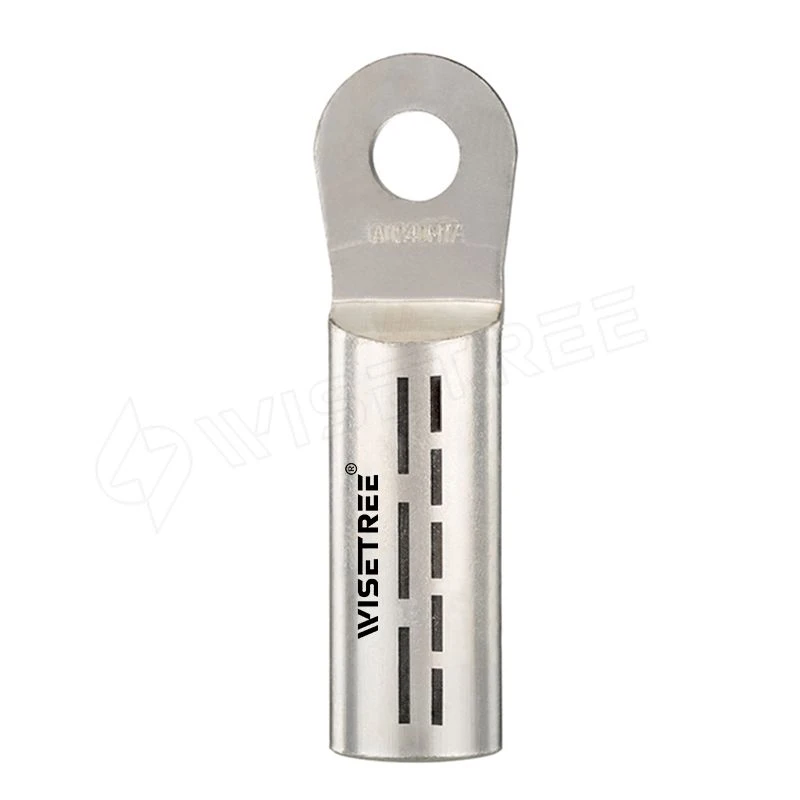
Which Lug Do I Need When the Conductor Is Aluminum
The equipment-side material is the single factor that decides the lug family, and getting it wrong creates a galvanic joint that corrodes in service. WISETREE states the rule plainly: an aluminium conductor connecting to a compatible aluminium connection takes an aluminium cable lug, while an aluminium conductor connecting to a copper terminal or copper busbar takes a bimetallic cable lug.
|
Connection requirement |
Recommended product |
What to confirm first |
|
Aluminium conductor to aluminium equipment |
Aluminum Cable Lug |
Conductor size, stud hole, palm dimensions |
|
Aluminium conductor to copper terminal or busbar |
Bimetallic Cable Lug |
Cable size, copper-side interface |
|
Equipment terminal material unknown |
Confirm material, then choose |
Do not assume aluminium |
|
Existing lug replacement |
Match existing product |
Drawing, sample or dimensions |
If the equipment terminal material is uncertain, stop and confirm it before ordering. A bimetallic lug is not a universal upgrade over an aluminium lug; it exists specifically to bridge the aluminium-to-copper interface, and using one where both sides are aluminium adds cost and a second transition with no benefit.
How Does Conductor Construction Change the Lug Barrel
Aluminium conductors are not all the same shape, and the barrel must match the conductor construction or the crimp will be loose. WISETREE lists solid, stranded, compacted and sector-shaped constructions as separate selection inputs, and each changes how the conductor fills the barrel.
A solid aluminium conductor seats differently from a stranded one, and a compacted or sector-shaped conductor needs a barrel inner diameter matched to its compacted diameter rather than its nominal cross-section. If you size the barrel from the cable label alone, a compacted conductor can leave a gap that produces a high-resistance crimp. State the construction on the enquiry, not just the mm² or AWG size, and confirm the barrel inner diameter against the actual conductor.
What Dimensions Must Match the Equipment Stud
Beyond the barrel, the palm and stud hole decide whether the lug fits the equipment at all. The specification checklist WISETREE publishes for aluminium lugs lists the parameters you should confirm before ordering.
|
Parameter |
Why it matters |
Confirm against |
|
Conductor size (mm² / AWG) |
Sets barrel and crimp die |
Cable label and construction |
|
Barrel inner diameter |
Must accept the conductor |
Actual conductor, not nominal |
|
Barrel length |
Crimp coverage and pull-out strength |
Selected product |
|
Stud hole |
Must fit equipment stud |
Equipment stud diameter |
|
Palm width |
Must fit terminal pad |
Equipment mounting space |
|
Palm thickness |
Must clear clamp height |
Mounting requirement |
|
Overall length |
Clearance in cabinet |
Installation space |
The stud hole and palm width are the two that cause on-site rejection: a lug with the right barrel but a stud hole that does not match the equipment stud cannot be installed without drilling, which weakens the palm. Where cabinet space or cable routing is tight, also confirm the overall length so the lug does not foul an adjacent terminal.
Aluminum Lug, Bimetallic Lug or Copper Lug
Buyers sometimes ask which lug family is superior, but the question is misplaced because the three are not interchangeable. The table separates them by where each belongs.
|
Lug family |
Use when |
Not the right choice when |
|
Aluminum Cable Lug (TCL-S, AU, DL, DLA) |
Aluminium conductor to aluminium equipment |
Equipment side is copper |
|
Bimetallic Cable Lug |
Aluminium conductor to copper terminal or busbar |
Both sides are aluminium |
|
Copper Cable Lug |
Copper conductor termination |
Conductor is aluminium |
|
Aluminum Connector (GL, GLB, GLI) |
Aluminium-to-aluminium inline joint |
Joining to copper without transition |
Aluminium lugs and connectors from the GL, GLB and GLI families handle the aluminium-to-aluminium inline joint, while copper lugs remain the termination for copper conductors. Mixing these by price alone creates the galvanic and fit problems described below.
Where Aluminum Lugs Work and Where They Fail
Aluminium lugs suit aluminium-conductor distribution, switchgear, transformer and industrial terminations where the equipment interface is aluminium-compatible. They are lighter and lower-cost than copper for the same current rating, which matters on long cable runs and in weight-sensitive panels.
The failure modes are specific. Oxidation at an aluminium surface raises contact resistance, so the joint needs proper preparation and, where specified, an anti-oxidant compound — do not treat an aluminium termination like a copper one. A galvanic joint from pairing an aluminium lug with a copper terminal without a bimetallic transition corrodes and heats. A loose crimp from a mismatched barrel inner diameter or wrong die pulls out under load, and a stud hole drilled to fit the equipment weakens the palm and should be avoided by ordering the correct hole in the first place. These are procurement and installation details, not product defects, which is why the specification checklist belongs on the order rather than in a follow-up call after delivery.
What to Put on the Aluminum Lug Enquiry
Send a complete specification so the delivered lug matches the job:
- Conductor material and construction (solid, stranded, compacted, sector)
- Conductor size in mm² or AWG
- Equipment-side material (aluminium or copper)
- Stud hole diameter and palm width or drawing
- Required barrel length and overall length
- Installation method (compression) and crimp tool if fixed
- Surface requirement and applicable standard
- Quantity, and drawing or sample for non-standard items
WISETREE produces non-standard aluminium lugs against a drawing, sample or dimensions, and for an existing replacement the fastest route is to send the old lug or its drawing so the new one matches. Where the termination is aluminium-to-copper, route the enquiry through the bimetallic cable lugs range and confirm the copper-side interface at the same time.
Manufacturer Recommendations From WISETREE
We advise buyers to fix the equipment-side material first, then match the barrel to the conductor construction, then confirm the stud hole and palm against the equipment drawing before comparing price. For aluminium-to-copper joints, specify a bimetallic lug rather than adapting an aluminium one, and for non-standard panels send the drawing so the palm and stud hole are correct on the first delivery. Our full cable lugs and terminals and connectors ranges cover the copper, bimetallic and mechanical options if the conductor or equipment side changes.
FAQ
Q: Can I use an aluminium cable lug on a copper busbar?
A: No, not directly. An aluminium conductor meeting a copper busbar needs a bimetallic cable lug to bridge the interface and avoid galvanic corrosion. Use a standard aluminium lug only when the equipment side is aluminium-compatible.
Q: Why does conductor construction matter if the size is the same?
A: Compacted and sector-shaped aluminium conductors have a different filled diameter than stranded or solid conductors of the same mm². The barrel inner diameter must match the actual conductor, or the crimp leaves a gap and runs hot.
Q: What do the TCL-S, AU, DL and DLA series mean?
A: They are WISETREE aluminium cable lug series covering different conductor sizes, mounting dimensions and termination requirements. Pick the series by conductor size and equipment interface, then confirm the stud hole and palm against the model drawing.
Q: How do I order a non-standard aluminium lug?
A: Send a drawing, sample or the required dimensions including conductor size, stud hole, palm width, barrel length and overall length. WISETREE produces custom aluminium lugs against those inputs for non-standard panels and equipment.
Q: Which aluminium connector do I use for an inline aluminium joint?
A: For aluminium-to-aluminium inline joints, the GL, GLB and GLI aluminium connector series apply. Keep the joint aluminium-to-aluminium; if one side is copper, move to the bimetallic range instead.
Request an Aluminum Cable Lug Quotation From WISETREE
If you are terminating aluminium conductors in switchgear, transformers, distribution or industrial equipment, send WISETREE your conductor size, construction and equipment-side material to wisetree@wisetreepower.com and we will specify the correct aluminum cable lug or aluminum connector from our range, with custom sizes available against a drawing or sample.
More News
-

-

Oct. 20, 2026
-