
How to Choose the Right Earth Rod: Material, Diameter, Length and Driving Method?
Oct. 12, 2026
If your installation needs a driven ground electrode, the safe default is a copper-bonded or stainless steel earth rod in the 12–25 mm diameter range with threaded couplers for deep driving — but the correct choice depends on your soil resistivity, required driving depth, and local earthing standard, so confirm those three values before fixing the material. WISETREE supplies a full earth rod range covering copper-bonded, stainless and copper-clad variants for substations, telecom, rail, solar, wind and industrial grounding, and the selection logic below is built around the real part tables we publish rather than generic rules.
Summary. Pick the rod material by corrosion environment (stainless or copper-bonded for coastal, chemical and high-resistivity sites), the diameter by fault current and mechanical strength (16–25 mm covers most distribution and substation work), and the length by the depth to low-resistivity soil plus the coupling system that lets you drive past 1.8 m. Match the decision to a documented soil resistivity test and the applicable standard, then confirm dimensions against the model specification.
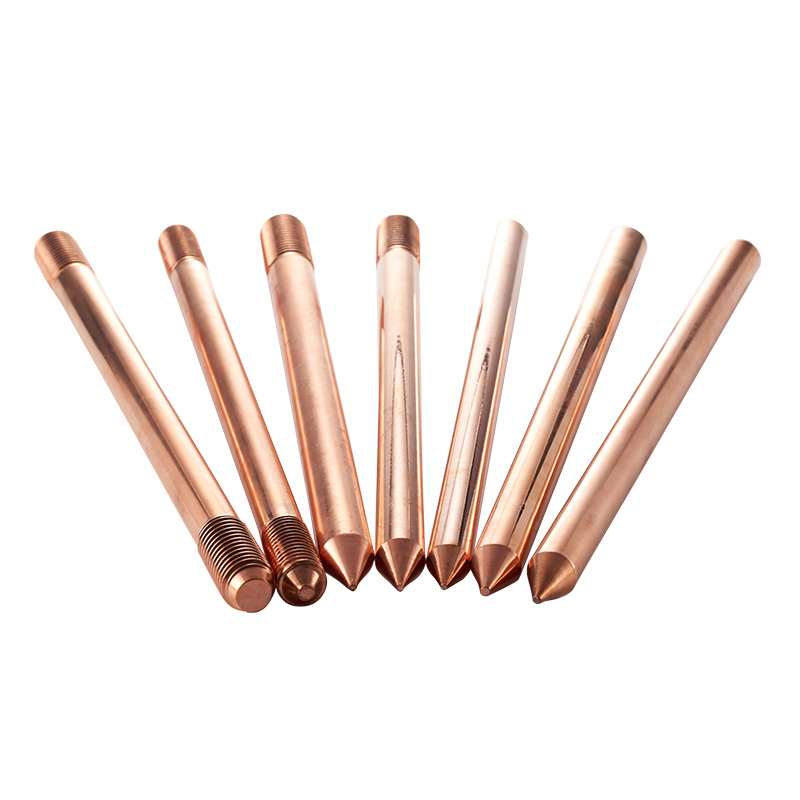
What Material Should the Earth Rod Be Made From
The first purchasing decision is the rod material, as it directly affects service life, corrosion resistance, and overall cost. WISETREE offers a range of grounding rods in pure copper, stainless steel, copper-plated, and galvanized options, allowing customers to choose the right material based on their installation environment and project requirements rather than price alone.
| Material family | WISETREE series example | Best-fit environment | What to verify before ordering |
| Copper earth rod | ERT/ERTS/ER | Projects requiring high electrical conductivity | Confirm copper purity and rod dimensions. |
| Copper-Plated | CER/SER | Applications balancing strength and cost | verify copper layer thickness and bonding quality. |
| Galvanized | GGR | Cost-sensitive electrical installations | Confirm galvanizing method and zinc coating thickness. |
| Stainless Steel | SS | Moist or corrosive environments | Confirm stainless steel grade,such as 304 or 316. |
A stainless steel rod such as our Earth Rod SS resists moisture, salt spray and UV exposure and is a sound choice where the soil is not aggressively corrosive. For coastal, petrochemical or high-resistivity sites, a copper-bonded rod usually outlasts a plain steel rod because the conductive layer keeps resistance low even after decades of corrosion. If a supplier lists a model such as CER, ER, SER or GGR without disclosing the alloy in the published table, treat the exact composition as unconfirmed and ask for the material certificate.
How Do Diameter and Length Affect Performance
Diameter and length are the two dimensions that appear on every part number, and they are the ones you can verify directly against our tables. Diameter drives mechanical strength and current-carrying surface; length drives how far the electrode reaches into lower-resistivity soil.
Our Earth Rod SS series runs in three diameters — 16 mm, 19 mm and 25 mm — with lengths from 1200 mm to 3000 mm. The 25 mm rod at 3000 mm (SS2530) weighs 12.24 kg, while the 16 mm at 1200 mm (SS1612) weighs 1.87 kg, so diameter also sets handling and transport load. The Earth Rod CER series covers 12 mm, 14 mm, 16 mm and 20 mm diameters at 1200–1800 mm lengths, and CER2015 (20 mm × 1500 mm) weighs 4.19 kg. CER also notes that other dimensions can be customized as requested, which matters when a standard length does not reach stable soil.
For most distribution and substation earthing, a 16–20 mm diameter rod is adequate mechanically; move to 25 mm when the rod must survive hard driving through rocky soil or carry higher fault current. Length is the stronger lever on resistance: a single 3000 mm rod will usually beat two 1200 mm rods driven separately because it reaches deeper, lower-resistivity layers.
When Do You Need Threaded Couplers for Deep Driving
The practical limit of a single driven rod is about 1.8–2.0 m before the head damage and driving difficulty rise sharply. When the design calls for a deeper electrode, you need a rod with threaded ends and couplers rather than a longer one-piece rod.
Our Earth Rod ERTS series is built for exactly this: diameters 8 mm, 10.5 mm, 12 mm, 13.5 mm and 14.2 mm, lengths 1000–1800 mm, with coupler threads specified as M12, 1/2 inch and 5/8 inch. The thread type is a procurement detail you must confirm — ERTS1210 and ERTS1212 use a 1/2 inch thread, while ERTS1312, ERTS1315, ERTS1412, ERTS1415 and ERTS1418 use a 5/8 inch thread, and the smaller ERTS810, ERTS1010 and ERTS1012 use M12. If you order couplers that do not match the rod thread, the joint will not seat and the driving string fails in the field.
Which Installations Suit Each Rod Type
Different end uses push the decision in different directions, and the table below maps common applications to a starting recommendation.
|
Application |
Starting recommendation |
Reason |
|
Urban distribution substation |
16–25 mm copper-bonded or stainless, 2400–3000 mm |
Stable low resistance, long life |
|
Telecom base station |
14–20 mm, threaded couplers for deep drive |
Limited space, deep stable soil |
|
Solar farm earthing |
Copper-bonded, multiple rods in a grid |
Large area, corrosion exposure |
|
Railway / signalling |
Stainless or copper-bonded |
Vibration and moisture |
|
Petrochemical plant |
Stainless or copper-bonded, certified |
Harsh, safety-critical |
|
Temporary or light industrial |
12–16 mm standard rod |
Lower fault demand |
What Limits the Choice and Where Rods Fail
Two limits catch buyers most often. The first is soil resistivity: a rod of any material cannot meet a target resistance if it sits in high-resistivity soil without enough length, enough rods, or a ground enhancement material. The second is corrosion allowance — a thin-clad rod in aggressive soil can lose its conductive layer within the project life, and you will not see it from above ground.
Common failure modes are a cracked driving head from over-driving a non-threaded rod past its limit, a mismatched coupler thread that opens the joint under fault current, and galvanic corrosion where a copper rod meets an aluminium structure without isolation. None of these show up on a price comparison, which is why the material certificate and thread specification belong on the purchase order, not in a follow-up email.
What to Confirm on the Earth Rod Order
Place the order against a short checklist so the delivered rod matches the design:
- Soil resistivity test result and target resistance
- Rod material and, where disclosed, alloy or copper thickness
- Diameter (mm) and total driven length
- Coupler thread type (M12, 1/2 inch or 5/8 inch) for deep driving
- Applicable standard (IEC, IEEE, BS or local)
- Quantity, packing and delivery date
- Required certificates (ISO, CE, ROHS where specified)
WISETREE products are supplied under ISO, CE and ROHS controls, samples are available for reference before volume ordering, and non-standard dimensions can be produced against a drawing. For a substation or solar project, send the resistivity figure and the standard, and we will match the rod series and length to it.
Manufacturer Recommendations From WISETREE
We advise buyers to fix the material from the corrosion environment first, then the diameter from fault current, then the length from soil layers, and only then compare price. For deep electrodes, specify threaded couplers explicitly and confirm the thread type on the order. Where a model table does not state the alloy, request the material certificate rather than assuming composition.
FAQ
Q: How deep should an earth rod be driven for a substation?
A: Start from the soil resistivity profile rather than a fixed depth; 2400–3000 mm rods are common where stable soil is deep. If one length is not enough, use threaded couplers to extend instead of relying on a single oversized rod.
Q: Is a stainless steel rod better than a copper-bonded rod?
A: Neither is universally better. Stainless resists corrosion well in many soils, while copper-bonded rods usually keep lower resistance as the surface ages. Choose by soil chemistry and required service life, and confirm the alloy or copper thickness with the supplier.
Q: What does the M12, 1/2 inch or 5/8 inch thread mean on ERTS rods?
A: Those are the coupler thread sizes used to join rod sections for deep driving. Matching the thread to the coupler is mandatory, because a mismatched joint will not seat and can fail under fault current.
Q: Can earth rod length be customized if a standard size does not fit?
A: Yes. The CER series notes that other dimensions can be customized as requested, and WISETREE produces non-standard rods against a drawing or sample. Provide the required diameter, length and thread on the enquiry.
Q: Which certificate should I request for an earthing project?
A: Ask for the material certificate and the relevant product certificates. WISETREE supplies under ISO, CE and ROHS controls, and for safety-critical sites confirm the exact standard (IEC, IEEE, BS or local) on the purchase order.
Request a Earth Rod Quotation From WISETREE
If you are specifying earth rods for a substation, solar farm, telecom or industrial grounding project, send WISETREE your soil resistivity result, target resistance and applicable standard to wisetree@wisetreepower.com and we will match the right material, diameter and length from our earth rod, earth bar and earth conductors range, with samples available before volume ordering.
More News
-

-

Oct. 20, 2026
-